Author Archive for David Kerr

Variant Magazine – Issue 41 Launch Event

Friday 6th May, 5.30pm

Invitation to the launch of Variant, issue 41, Spring 2011

Pick up the latest copy @ Aye-Aye Books, CCA, Glasgow

Aye-Aye Books is an independent book seller and publisher specialising in contemporary art and related literature.
www.aye-ayebooks.com

Centre for Contemporary Arts
350 Sauchiehall Street
Glasgow G2 3JD
cca-glasgow.com

The full back catalogue of Variant can be read online at:
www.variant.org.uk

The GSA was mentioned in the  last issue of Variant in an interesting article about the Incomprehensiveness of Art Education by John Beagles.

Myriad Editions First Graphic Novel Competition

Myriad Editions is pleased to announce the first ever competition for a first graphic novel in progress. The entry may be by a single author or may be a collaboration between a writer and artist.

The winner will have the opportunity to develop their work in progress with Myriad’s creative and editorial team with a view to being offered a contract and publication by Myriad in 2012/13.

The winner will be announced in January 2012 at the First Fictions Festival.

The closing date is Monday 1st October 2011.

The winning entry will be an extract from a narrative work in progress – fiction or non-fiction – and will be chosen purely on the strength and promise of the art and writing by a panel of expert judges, including:

Steve Bell, cartoonist (Guardian)
Hannah Berry, graphic novelist (Britten & Brulightly)
Ed Hillyer (Ilya), cartoonist (King Lear, Skidmarks) and author (The Clay Dreaming) Corinne Pearlman, Creative Director, Myriad Editions
Ian Rankin, author (Inspector Rebus series and other novels)
Bryan Talbot, graphic novelist (Grandville, Alice in Sunderland, The Tale of One Bad Rat)

More Information can be found at the Myriad Editions Site.

For lots of other comic and illustration themed competitions check the Things to Do section of Paul Gravett’s website.

School of Commons?

Proposal 1:
Self-organisation in Education:
with Stevphen Shukaitis and Glasgow Open School.
Saturday 30th April 6pm-8pm at the Glue Factory, 22 Farnell Street, off Garscube Rd.


We present the first in a series of two events aiming to bring together people interested in holding experiments in education this summer and anyone struggling with ideas and practices of learning, democracy, collectivity, curatorship, culture and knowledge production. We aim to combine space for open discussion of ideas and pragmatic arrangements for collaboration.

The event has been organised by Glasgow Open School, Glasgow People’s Assemblies, the Free Hetherington and thiscollection. A more detailed outline of the event can be found at the Glasgow Open School website.

Piloti’s Nooks and Corners

Private Eye’s Piloti has kindly granted me a three month licence to reproduce this article about the Stephen Holl building project .

Glasgow School of Art, designed as part of a competition in 1896 by Charles R. McIntosh, then a young assistant in the Glasgow firm of Honeyman & Keppie, is one of the most famous buildings in the world.

This subtle and eclectic stone structure, with its echoes of Scottish castles, Elizabethan architecture and “Queen Anne” and Arts and Crafts buildings in England, is gawped at constantly by hordes of starstruck architects. Its creator, “Rennie Mackintosh”, as he became known, has become a figure of myth as well as the patron saint of the Glasgow tourist industry. And two years ago, to mark the centenary of this truly wonderful work of architecture, the school announced a competition for an adjacent new building to replace the brutal concrete tower which the Mackintosh successor firm, Keppie Henderson & Partners, contrived to erect on the opposite side of Renfrew Street in 1970, when Glasgow was busy destroying itself.

Any new building on this sensitive site might be expected to respond to the character of the city and be deferential to poor old Toshie’s masterpiece. But no. Faced with 150 entries, including several from respected Scottish practices, the assessors surrendered to cultural cringe by plumping for a fashionable international superstar, Steven Holl of New York.

Holl paints as well as designs and is responsible for modishly angular and arbitrary new museum buildings in places like China, Norway and the US. He says things like: “Building transcends physical requirements by fusing with a place, by gathering the meaning of a situation.” But Holl has come up with a design which is scarcely respectful to Mackintosh.

At least the new building will run along the street line of Renfrew Street and incorporates the 1930s Assembly Hall. But that’s as far as it goes. Holl’s creation will rise much higher than Mackintosh’s block and, by having the top storey jutting forward, will overshadow it.

Whereas the original block is carefully and delicately detailed, Holl’s is a crude composition of plain surfaces and awkward angles. Facing Mackintosh’s facade, with its big north-facing mullioned and transformed windows, Holl proposes a recessed “landscape loggia… that gives the school an exterior social core open to the city. Natural vegetation with some stonework routes water into a small recycling water pond which will also reflect dappled sunlight on to the ceiling inside” — which suggests he has little understanding of Glasgow’s weather, especially in winter.

Mackintosh managed to provide practical, well-lit studio spaces that still work. But Holl, who drones on about a “new language of light”, proposes to waste space by having “Driven Void’ light shafts” inside the building to provide “direct connectivity with the outside world through the changing intensity and colour of the sky.”

Worst of all is the fact that this banal conception will be “coated in a thin skin of matte glass referencing Mackintosh’s stone skin”, whatever that may mean. Holl denies that all this southfacing glass will reflect too much light on to the old building, for: “This material is almost like alabaster. It is soft, without reflection.” As the Iron Duke once said, if you believe that, you’ll believe anything. But why glass at all? The character of Glasgow is of stone, and it is not necessary to imitate Mackintosh’s style to produce architecture which could be both original and yet harmonious — as the original School of Art was to the neighbouring tenements and villas.

Depressingly, this crude and insensitive design has met virtually no criticism in Scotland. Of course it was clever of Holl to team up with the Glasgow office, run by Ian Alexander and Henry McKeown (both graduates of the school), of the firm of JM Architects (not to be confused with RMJM who recently hired Sir Fred Goodwin [Eye 12551), for in Glasgow nobody likes to rock the boat. Naturally Seona Reid, director of the School of Art, considers that “the inventive use of light, material and section make it a worthy companion to Mackintosh, a striking building of which we will all be immensely proud”; but there has been remarkably little dissent from kow-towing to the American superstar among her members of staff. Ranks have closed: the Charles Rennie Mackintosh Society has rolled over, as has the Royal Incorporation of Architects in Scotland. Naturally the city council is all in favour.

Almost the only dissent has come from the distinguished Scots film-maker and pioneer in the rehabilitation of once-despised Toshie, Murray Grigor, together with Professor William JR Curtis, the (English) historian of modernism and the author of studies of Le Corbusier. In an open letter to the governors of the school and its staff and students, Professor Curtis writes: “The Holl project is lacking in urbanity and would not be out of place in a business park in China or the USA, but it is completely alien to Glasgow with its grid, urban grain, and sombre facades in stone and glass. Above all it fails to harmonise with Mackintosh’s marvellous building opposite. To respond to a historical context does not mean copying the existing, but it does mean interacting at several levels from overall volumes, to proportions, to materials”. I could not have put it better myself.

If Steven Holl’s arrogant matte glass lump is built, it will not just be a waste of £50m but another of modern Glasgow’s far too numerous architectural foul-ups.

‘Piloti’

GLASGOW School of Art, designed as part of a competition in 1896 by Charles R. McIntosh, then a young assistant in the Glasgow firm of Honeyman & Keppie, is one of the most famous buildings in the world.

This subtle and eclectic stone structure, with its echoes of Scottish castles, Elizabethan architecture and “Queen Anne” and Arts and Crafts buildings in England, is gawped at constantly by hordes of starstruck architects. Its creator, “Rennie Mackintosh”, as he became known, has become a figure of myth as well as the patron saint of the Glasgow tourist industry. And two years ago, to mark the centenary of this truly wonderful work of architecture, the school announced a competition for an adjacent new building to replace the brutal concrete tower which the Mackintosh successor firm, Keppie Henderson & Partners, contrived to erect on the opposite side of Renfrew Street in 1970, when Glasgow was busy destroying itself.

Any new building on this sensitive site might be expected to respond to the character of the city and be deferential to poor old Toshie’s masterpiece. But no. Faced with 150 entries, including several from respected Scottish practices, the assessors surrendered to cultural cringe by plumping for a fashionable international superstar, Steven Holl of New York.

Holl paints as well as designs and is responsible for modishly angular and arbitrary new museum buildings in places like China, Norway and the US. He says things like: “Building transcends physical requirements by fusing with a place, by gathering the meaning of a situation.” But Holl has come up with a design which is scarcely respectful to Mackintosh.

At least the new building will run along the street line of Renfrew Street and incorporates the 1930s Assembly Hall. But that’s as far as it goes. Holl’s creation will rise much higher than Mackintosh’s block and, by having the top storey jutting forward, will overshadow it.

Whereas the original block is carefully and delicately detailed, Holl’s is a crude composition of plain surfaces and awkward angles. Facing Mackintosh’s facade, with its big north-facing mullioned and transformed windows, Holl proposes a recessed “landscape loggia… that gives the school an exterior social core open to the city. Natural vegetation with some stonework routes water into a small recycling water pond which will also reflect dappled sunlight on to the ceiling inside” — which suggests he has little understanding of Glasgow’s weather, especially in winter.

Mackintosh managed to provide practical, well-lit studio spaces that still work. But Holl, who drones on about a “new language of light”, proposes to waste space by having “Driven Void’ light shafts” inside the building to provide “direct connectivity with the outside world through the changing intensity and colour of the sky.”

Worst of all is the fact that this banal conception will be “coated in a thin skin of matte glass referencing Mackintosh’s stone skin”, whatever that may mean. Holl denies that all this southfacing glass will reflect too much light on to the old building, for: “This material is almost like alabaster. It is soft, without reflection.” As the Iron Duke once said, if you believe that, you’ll believe anything. But why glass at all? The character of Glasgow is of stone, and it is not necessary to imitate Mackintosh’s style to produce architecture which could be both original and yet harmonious — as the original School of Art was to the neighbouring tenements and villas.

Depressingly, this crude and insensitive design has met virtually no criticism in Scotland. Of course it was clever of Holl to team up with the Glasgow office, run by Ian Alexander and Henry McKeown (both graduates of the school), of the firm of JM Architects (not to be confused with RMJM who recently hired Sir Fred Goodwin [Eye 12551), for in Glasgow nobody likes to rock the boat. Naturally Seona Reid, director of the School of Art, considers that “the inventive use of light, material and section make it a worthy companion to Mackintosh, a striking building of which we will all be immensely proud”; but there has been remarkably little dissent from

kow-towing to the American superstar among her members of staff. Ranks have closed: the Charles Rennie Mackintosh Society has rolled over, as has the Royal Incorporation of Architects in Scotland. Naturally the city council is all in favour.

Almost the only dissent has come from the distinguished Scots film-maker and pioneer in the rehabilitation of once-despised Toshie, Murray Grigor, together with Professor William JR Curtis, the (English) historian of modernism and the author of studies of Le Corbusier. In an open letter to the governors of the school and its staff and students, Professor Curtis writes: “The Holl project is lacking in urbanity and would not be out of place in a business park in China or the USA, but it is completely alien to Glasgow with its grid, urban grain, and sombre facades in stone and glass. Above all it fails to harmonise with Mackintosh’s marvellous building opposite. To respond to a historical context does not mean copying the existing, but it does mean interacting at several levels from overall volumes, to proportions, to materials”. I could not have put it better myself.

If Steven Holl’s arrogant matte glass lump is built, it will not just be a waste of £50m but another of modern Glasgow’s far too numerous architectural foul-ups.

‘Piloti’

Blindness and Visual Communication

Last year I participated in an artist residency programme called And’art in Marrakech. As part of the residency artists were given the opportunity to help facilitate workshops at a Blind School.

Here’s a quick summary of what happened in the workshops written by the organisers of the residency.

The workshops were part of And’Art Marrakech held by Terre Sans Frontière and were based at the University of Law in Marrakech. The idea of doing this project stemmed from trying to break the boundaries between the visually impaired and the sighted. This was realised by bringing the sighted and the visually impaired together in the same space to share their experience of the surrounding environment.

Photography Workshop

Four visually impaired students were given disposable cameras to document twenty four hours of their everyday life. They were to take a picture by their senses, for example when they heard or smelt something that triggered a memory or idea.


The students made a description of the reasoning behind each photograph by Dictaphone or Braille.


After processing the pictures, a textual annotation was added in Arabic, English and Braille near each picture.


Atika -
“I felt the warmth coming from a lamp and I am stood under the light while taking a picture of it.”

“I was lost on an empty pave then I took the picture so you can tell me where I was.”

“Picture of five fountains that I used to take pictures of when I was not blind, and now I’m taking a picture of them and I’m blind.”

Mostapha -
“I take a picture of the sky because when I’m thinking I look up.”

“I heard a sound that only comes from something that seems to be over the wall but I don’t know what it is.”

“What you can see in my pictures is that I am an introverted person because all the places I took in my pictures are closed.”

Fatima Ezzahra -
“This picture was taken at 11am because I was hearing a lot of noise that showed me that the place was full of tourists and Moroccan people, I heard voices and chants and storytellers and then I felt like if I was drawing a picture in my head of everything I was hearing.”

“This picture was taken at 11.15 am near the jewels shop, I touched some jewels with my hands to see them.”

Badr -
“I remember, we watched a soccer match and I am sad because my team its losing (Real Madrid).”


Their work was exhibited in Remp’Art Gallery, Gueliz, Marrakech 24 September – 5 October 2010. The Photography workshops for the visually impaired were led and facilitated by Amy Smyth, Saad-Eddine Said and Thea Panter, with much appreciated help from Fouad Said and Salah Bekri in collaboration with the visually impaired students who are members of IDMAJ at Qadi Ayad University (Marrakesh).

Atika -

“I felt the warmth coming from a lamp and I am stood under the light while taking a picture of it. ”

” I was lost on an empty plave then I took the picture so you can tell me where I was. ”

“Picture of five fountains that I used to take pictures of when I was not blind, and now I’m taking a picture of it and I’m blind.”

Mostapha -

“I take a picture of the sky because when I’m thinking I look up. ”

” I heard a sound that only comes from something that seems to be over the wall but I don’t know what it is. ”

” What you can see in my pictures is that I am an introverted person because all the places I took in my pictures are closed.”

Fatima Ezzahra -

“The picture have been taken at 11am, that was because I was hearing a lot of noise that shows me that the place was full of tourists and Moroccan people, and I hear voices of chant and storytellers and then I felt like if I was drawing a picture in my head of all was hearing. ”

” The picture have been taken at 11.15 am near the jewels shop, and I touch some jewels with my hands to see them. ”

RIGHT TO THE CITY: EDUCATION FORUM

TIME: Saturday, 22nd January 2011, 12.30-4.30.

PLACE: Partick Burgh Halls, Burgh Hall Street, Glasgow.

Right to the City Forum has been running events since last summer creating spaces for discussion, and exploring ideas of community activism and how to define our own lives.

We are hosting an education forum on Saturday 22nd January at Partick Burgh Halls, Burgh Hall Street, Glasgow, from 12.30-4.30 (note: 12.30 for 1.00 start, prompt!). The venue is just off Dumbarton road, Partick, only two mins from Partick rail and subway lines: http://maps.google.co.uk/maps?q=55.87129974,-4.30905008

The Forum will attempt to open up the education debate beyond an immediate defence against the cuts, and make a useful contribution not only to the education movement but to wider activity against the marketisation of cultural and public space. Members of the forum are not aligned to any one party or political position, however, the ‘Really Open University’, in the statement below, express some of our concerns very well: http://reallyopenuniversity.wordpress.com/

“The recent response to the marketisation of higher education has given a voice and a collective identity to a discontent stretching beyond funding constraints. It is now time to respond as well as create, looking for new action and dialogue for the future. We want to open up debate, not close it down.

Issues to consider: What is worth salvaging from the university system? What strategies do we have for attracting those who ought to be sympathetic: passive academics, apathetic students, individuals outside of the University, young people? How to operate within the academy without being corrupted by it? What could The University be? How do we make this happen?”

In short, the Forum will attempt to ‘re-imagine the school and the university’ – fighting for what education should be, not just preserving what it currently is.

We will be looking at wider cuts/resistance in education and not just the university. We also recognise that education is not confined to educational establishments, and that those outside of educational establishments have just as much if not more to teach than those in education. The event is open to all. It is an opportunity to meet other like-minded people to discuss the deep political implications of how the education system manages human potential.

A set of short texts will introduce the main themes the forum will explore. These will be handed out to all participants on the day and used in the initial discussion session to develop more in-depth discussion from people’s responses. Some themes to be explored include: student debt as training for life, the function of education in market relations, transformative potential of education/what education might be, uneven cuts to arts and humanities, academic ‘autonomy’?, disciplinary role of cuts/debt, crisis of aspiration (hope), wider cuts beyond education, and linking of struggles within and beyond education.

Best Wishes,

Right to the City Forum.

Facebook event: http://www.facebook.com/event.php?eid=143062559084259

This event is hosted by Strickland Distribution http://www.strickdistro.org/. It is supported by ARIKA http://www.arika.org.uk/.

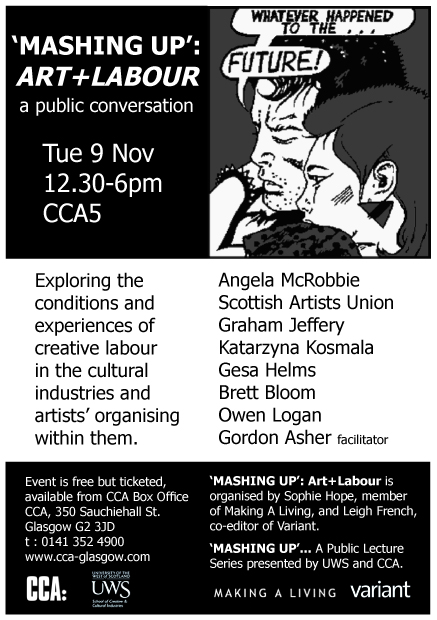
MASHING UP!

A Public Lecture Series presented by UWS and CCA. This ongoing lecture series stimulates critical, transdisciplinary research communities to discuss advanced knowledge and to build networks of excellence among producer communities.
‘Mashing up’ [definition]
“a mashup is a web page or application that combines data or functionality from two or more external sources to create a new service. The term mashup implies easy, fast integration…to produce results that were not the original reason for producing the raw source data” (Wikipedia, 2009).

The lecture series exhibits the values of new media culture to explore synergies between institutions, ideas and disciplines. This aspiration originates with the UWS and CCA partnership, which extends to the specific areas of inquiry that we pursue. It advances the core mission of each organization to initiate applied, international research opportunities through experimental, local dialogue to foster collaborative, bottom-up, sustainable practices of development.
We want attendees to blog, photograph, film, tweet and do all they can to share the content of these talks to democratize access to knowledge.

Arts Group Emerging Worker’s Report

Arts Group

To follow up on the post about the Carrotworkers Collective I would recommend having a look at the Arts Group website.  Very Good resource. They recently made an in-depth report about Internships and Unpaid Work Placements.

“The Arts Group is pleased to announce the official release of our report into internships and policy on improving them, ‘Emerging workers: a fair future for entering the creative industries’

The Arts Group is calling for legislation governing the practice of work experience, internships and placements. In its “Emerging Workers” document the Arts Group puts forward the case that Government action is needed in order to protect students and graduates in the arts and creative industries.

Many arts organisations and businesses are reliant upon unpaid workers, both on work experience and on longer term placements. Whilst the Arts Group recognises that some of these organisations are run on low budgets, it is not in the interest of diversity, equality or creativity for internships to remain as the preserve of the well off.

Kit Friend, Chair of the Arts Group commented “Access to the creative professions should be based on ability, not means. As the labour market is near saturated with those financially able to take up unpaid placements, equal access to the creative professions will not be realised unless internships are regulated by government.”

The Arts Group recognises that the creative sector is made up of a large number of small and medium enterprises, and calls for funding and bursaries to be made available to employers so that they are able to continue to offer internships that are genuine training and development opportunities.”

Right to the City

RTTClogo

Just to add another David Harvey related link to the blog.
Here is a link to a really interesting article he wrote for the new left review titled ‘The Right to the City.’

In it he argues that

“The freedom to make and remake our cities and ourselves is  one of the most precious yet most neglected of our human rights.”

This idea has helped to inspire the Right to the City social movement that first emerged in New York in 2007 as a unified response to gentrification and a call to halt the displacement of low-income people, LGBTQ, and youths of color from their historic urban neighborhoods. Through shared principles and a common frame and theory of change, RTTC is building a national and international movement for urban justice, human rights, and democracy.

There will be a Right to the City forum in Glasgow on the 24th of July at Kinning Park Complex. Well worth checking out.

Address Details Below:

Kinning Park Complex, Cornwall Street, Glasgow, G41 1AQ (Kinning Park
subway opposite). 12.30 for 1.00 start prompt, until 5.00. Saturday,
July 24th.

Map:
http://www.streetmap.co.uk/map.srf?x=256889&y=664430&z=0&sv=G41%201AQ&st=PostCode&lu=N&tl=~&ar=y&bi=~&mapp=map.srf&searchp=ids.srf

Silent Witness

silentwitnesses

Silent Witnesses: Graphic Novels Without Words
Curated by Darren Diss

Venue: Danes Terrace, Lincoln
29 May 2010 to 30 Aug 2010
Admission price: free

This exhibition brings together the work of internationally recognised artists and illustrators from around the world working in Graphic Novel form. Spanning publications from the early twentieth century to the present day, the works contained in the exhibition are distinct in that all use the capacity of images alone to communicate narrative, functioning entirely without the use of text.

The exhibition celebrates the book form and in particular the Graphic Novel as an increasingly popular medium for artists and explores its enduring appeal to readers of all ages. By focussing on works without text it examines the underlying structure and mechanics of developing a Graphic Novel, exposing it as a unique art form. It looks at the Novel in the true sense, as an extended sequence conveying a narrative. The show includes preparation and working drawings, writings, flat plans, sketch books and character studies and associated works alongside complete book-works to reveal the various developmental stages in creating a Graphic Novel.

The exhibition combines works from a wide range of cultural contexts, from modern popular Graphic Novels, with scratchboard images by Eric Drooker produced for his novel ‘Flood’, to woodcuts by Frans Masereel for his his 1925 work ‘Die Stadt’, to original drawings by Sara Varon for her well loved books, ‘Sweater Weather’, ‘Robo and Hund’ and ‘Chicken and Cat’. Also in the show will be a large scale flat-print version of ‘A-Z’ by Lars Arrhenius, a novel produced on the iconic A-Z map of London. Shown in print form it allows the viewer to scan the intersecting narratives sewn through the map in a single image, creating ever new readings.

Works for the exhibition have been loaned to The Collection from the British Museum, Moderna Museet, Stockholm, Klinspor Museum, Offenbach, Scott Eder Gallery, New York, and from the exhibiting artists.

The show’s curator, Darren Diss, is an established illustrator and Senior Lecturer in Illustration at The University of Lincoln. He has a specialist academic research interest in Textless Narratives.

Become One of Menie

4609889042_1c973a5a4b

4609893848_d1b0c3b4cc

Dear Friend,

Trump has arrived in Aberdeen and we have a present for him, but he’s not going to like it.

Join us in The Bunker now.

Today we are launching The Bunker, a plot of land, slap bang in the middle of where Trump wants to build his golf course. Just like Greenpeace’s Airplot that recently helped stop Heathrow’s 3rd runway, The Bunker is a plot of land that thousands of us can add our names to. If it comes to the point where Aberdeenshire Council agrees to Trump’s demands to throw local people off their land, they’ll have to deal with all of us too.

You can be part of the plot too. Join us in The Bunker now.

Over 15,000 of us signed the petition supporting Aberdeenshire Council to rule out Trump’s demands for the use of compulsory purchase orders in order to throw local families out of their homes, but they chose not to act. A recent opinion poll told us that Trump now has just 13% support on this basis. Aberdeenshire Council continues to fail to protect local families, from Trump’s demands for forced evictions.

So let’s take this matter into our own hands and stand side by side with the local families against the bully Donald Trump.

Please forward this email far and wide. Everyone is welcome in The Bunker. And we’ll be creating some fun on the site of The Bunker in the future, so keep an eye out for updates.

Many thanks.
Tripping Up Trump

MESHO

this probably wasn’t distributed up here as Squatters Rights don’t exist in Scots law…

MESHO 

INDYMEDIA SOMEWHERE
Squatters In Tabloid Paper Shocker

MESHO, a spoof paper has been produced for the weekend of squatted autonomous spaces happening in cities across Britain (and everywhere else), this weekend.

MESHO, The 16-page tabloid spoof paper about squatting, homelessness and autonomous spaces is out! Apeing the METRO masthead, watch out if you see what looks like a METRO on a tube train or bus – it might be a MESHO.

Look out for MESHO in all the squatted/autonomous spaces opened up this weekend in cities across Britain.  Allegedly the paper nearly didn’t happen because three separate printers pulled out
at the last minute fearing a legal comeback – or claiming they didn’t have insurance. One excused themselves because they print METRO, before another finally obliged at the last minute.

What does MESHO mean? Well it looks like METRO but is an anagram of HOMES. So there.

Download MESHO on pdf (16 page, tabloid size, 4.7mb) at
www.schnews.org.uk/satire/pdf/mesho.pdf

In the Shadow of Shadow

In_the_shadow_of_shadow

With the support of Uninstal, as part of a two day exploration of critical urban praxis with radical sound art collective Ultra-Red, The Strickland Distribution are hosting a public walk on Sunday 9th May. The walk is intended as a means to investigate contemporary urban dispossession as a consequence of gentrification in light of historical forms of primitive accumulation in the city. Led by independent writer and researcher Neil Gray, in collaboration with a range of activists and artists and housing and community groups, the walk will take a digressive route through George Square, the branded ‘Merchant City’, Glasgow Green, and the Barras Market. In a form of live critical praxis, the walk will aim to illuminate such shadowed areas as the ‘Cancer of Empire’ and the dead hand of Victoriana; the secret of primitive accumulation, past and present; ‘the Selfridges effect’ and the rent-gap; the ‘arts-led property strategy’ and affective labour; slums, tower blocks and penthouses, and the continuing crisis in housing; and the neoliberal pulverisation and commodification of social spaces.

The title of the walk refers to ‘Shadow’ and his ‘Midnight scenes and social photographs’, a paternalist Victorian account of Glasgow slums written in 1858. In the Shadow of Shadow, we propose instead an investigative ‘history from below’; a critical exploration of gentrification set in the historical contexts of the ‘second city of Empire’ and contemporary city-building. While Victorian paternalists like Shadow promoted top-down, moralistic solutions to mitigate the problems of the urban poor, we know that social change only ever comes with broad-based organising from below. Participating groups such as the Scottish Tenants Organisation, Glasgow Games Monitor 2014, and the Glasgow Residents Network are already active in Glasgow, and this walk aims to provide the means for critical self-reflection and collaborative exchange, as well as instigating and sustaining wider solidarity and activity between anti-gentrification researchers, activists, community groups, planners and artists in Glasgow. We welcome all those with an interest in this project.

Please note that the walk will be audio recorded by Ultra-Red. Recordings from the event will then be used the following Sunday 16th May in sound workshops that explore the issues raised on the walk and the possibilities for new and ongoing forms of organisation and resistance to gentrification in Glasgow.

Day 1: Sunday 9th May. Meet 1pm at Queen Victoria statue (with horse) George Square.

A public walk from George Square to the Barras market, bringing in contributions from researchers, activists and artists in a form of live critical praxis (time: 1-4pm approx.).

Followed by a screening from Document’s archive of ‘Drumchapel – The Frustration Game’ (20 mins, de-classed elements, 1989) and discussion (time: 4-7pm approx.) in Laurie’s Bar, 34-36 King Street, Glasgow, G1 5QT Map: http://tinyurl.com/34v9n8z

Day 2: Sunday 16th May, 1-5pm, Kinning Park Complex, 40 Cornwall Street, Glasgow, G41 1AQ Map: http://tinyurl.com/32x7y2h

A practical sound workshop with Ultra-Red bringing together walk participants to discuss the issues raised during the walk. The aim of these workshops is to facilitate a deeper understanding of gentrification, and to instigate and sustain wider solidarity and activity between anti-gentrification researchers, activists, community groups and artists in Glasgow.

Participants include:

Neil Gray (writer and researcher)
Leigh French (co-editor, Variant magazine)
Simon Yuill (artist and writer)
Libby Porter (University of Glasgow, Department of Urban Studies; Planners Network UK)
John Cousins (radical researcher and historian)

Links/Groups:

The Strickland Distribution: http://www.strickdistro.org
Uninstal: http://www.arika.org.uk
Ultra-Red: http://www.ultrared.org/directory.html
Document – International Documentary Film Festival : http://www.docfilmfest.org.uk
Variant: http://www.variant.org.uk
PNUK: http://www.pnuk.org.uk
Scottish Tenants Organisation: http://www.scottishtenants.org.uk/about_us.htm
Glasgow Games Monitor 2014: http://gamesmonitor2014.wordpress.com
Glasgow Residents Network: http://glasgowresidents.wordpress.com
The Burgh Angel: http://burghangel.wordpress.com
East End Eye: http://gamesmonitor2014.wordpress.com/east-end-eye-paper/
South Side Crane: http://southsidecrane.wordpress.com/category/events/

Some background research by Neil Gray from Variant magazine:

‘Constructing Neoliberal Glasgow: The Privatisation of Space’
http://www.variant.org.uk/25texts/neolib25.html

‘The Clyde Gateway: A New Urban Frontier?’
http://www.variant.org.uk/33texts/3_V33gray.html

‘Glasgow’s Merchant City: An Artist-Led Property Strategy’
http://www.variant.org.uk/34texts/mechantcity34.html

‘The Tyranny of Rent’
http://www.variant.org.uk/37texts/13RentTyranny.html

The Untamed Tiger

falmouth

The Untamed Tiger: the illustrator and the self initiated project

MA Illustration: Authorial Practice at University College Falmouth hosts its 8th annual illustration forum

Friday 12 March 2010, 9.30am – 4.30pm
Woodlane Lecture Theatre, Woodlane Campus, Falmouth
Tickets: £15 external visitors, £5 UCF staff and students

A day of presentations and debate on the theme of enterprising illustrators who generate their own projects, creating their own employment and work on their own terms. The Forum will explore the development of new autonomies and enterprising initiatives in illustration.

No Mean Streets and the Glasgow Reshuffle

no_mean_streets

No Mean Streets is a new social network that intends to encourage cycling, improve the attitudes of other motorists towards cyclists, and hopefully improve the proficiency for cycling in Glasgow. It has been set up as part of an arts project led by The New Social Art School, who will also be participating in the upcoming Glasgow Reshuffle at the Pierce Institute on Saturday the 5th of Febuary.

re-shuffle_for_web

The Reshuffle is a free hands on event held at the Pearce Institute annually. It is an event to start the year on a positive note, get some people into a community centre and have them leave thinking they have seen something new that could be of interest to them.

Here’s a small selection of links to organisations participating this year:
Galgael Trust, Open Source Mapping, Unity, Burgh Angel, Gamesmonitor 2014, Documents Film Festival, Radical Independent Bookfair, Electron Club, Glasgow Social Centre, Sunny Govan Radio, Bridge Network

A Manifesto for Illustration

Mackinnon_Euthanasia

“There are not enough magazines or if you prefer all magazines are useless…”

I was luckily given permission to photocopy the above introduction to Issue 51 of Arc Magazine. I found it in the old offices of OZ Magazine in Notting Hill, now home to a most civilised graphic design practice. The magazine comprised a series of loose leaf lithographic prints by some of the best illustrative talent the 70′s had to offer. It was edited by Sue Coe and Stewart Mackinnon and includes works by The Brothers Quay, Terry Dowling, Eduardo Paolozzi, Douglas Dent and Andrzej Klimowski. Perhaps the most interesting contributor not to have written a comment in the introduction is Sue Coe and to compensate for this I thoroughly recommend this article about her published in issue 21 of Eye magazine.