Monthly Archive for November, 2010

Page 2 of 2

Talks, Fri 12th Nov, 4pm

Talks this week in 2nd year studio, fri 12th Nov 4pm:

Arne Bellstorf, Illustrator: http://www.bellstorf.com
Dele Adeyemo, Architect, Designer: http://www.pidginperfect.com/

All welcome.

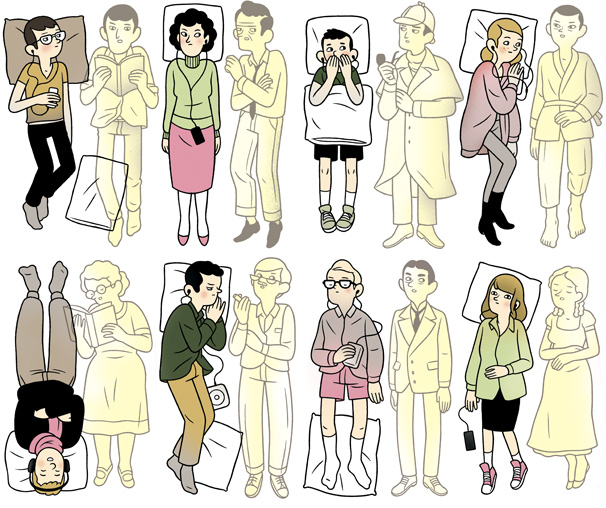
Illustration: Arne Bellstorf, for ZEIT Literatur Nr. 12/2009, www.zeit.de

I Can Haz Youtube Culture

For their August journal Embassy Gallery in Edinburgh curated an online discussion about the impact of the Internet* on visual culture, the online version of which can be accessed here.

* We were getting something proof-read the other day, and apparently the Internet should have a capital ‘I’, like God.

That’s More Laika (it)

We posted a while back about LAIKA, Eine dynamische Schrift (the dynamic typeface). The face has developed further, and you can now interact with it via a web-based processing site (if your browsers got all the right bits).

Jet Set Willy

Jodi – A great duo (Joan Hemmskerk and Dirk Paesmans) from The Netherlands who have been using the web as a medium to make work ‘from the beginning’ 1994? Some projects are irritatingly intrusive but altogether a clever and subversive use of the internet’s capabilities. You have to keep typing in jodi[dot]org to get new projects, I suggest a copy and paste method.

Dead Drops

Dead Drops is a fantastically clandestine and covert way to share information. Thanks to Philip Blakie, PD.

Loudest isn’t always bestest

Some interesting work by Dentsu/BERG looking at how we may be using screens in the near future (more often but also more quietly).

via the always excellent Russell Davies

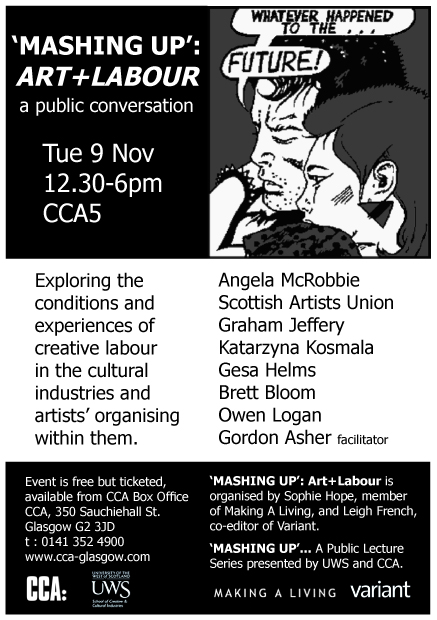
MASHING UP!

A Public Lecture Series presented by UWS and CCA. This ongoing lecture series stimulates critical, transdisciplinary research communities to discuss advanced knowledge and to build networks of excellence among producer communities.
‘Mashing up’ [definition]
“a mashup is a web page or application that combines data or functionality from two or more external sources to create a new service. The term mashup implies easy, fast integration…to produce results that were not the original reason for producing the raw source data” (Wikipedia, 2009).

The lecture series exhibits the values of new media culture to explore synergies between institutions, ideas and disciplines. This aspiration originates with the UWS and CCA partnership, which extends to the specific areas of inquiry that we pursue. It advances the core mission of each organization to initiate applied, international research opportunities through experimental, local dialogue to foster collaborative, bottom-up, sustainable practices of development.
We want attendees to blog, photograph, film, tweet and do all they can to share the content of these talks to democratize access to knowledge.
Design Does Not Solve The Darkness

As you know, I’m always excited to find new publications to spend my massive GSA salary on, and The National Grid is a recent discovery, attempting to ‘chart a path through the murky wasteland between the professional practice of graphic design and its troublesome academic manifestations’.

Already these two editions (#5 and #6) have thrown up some interesting links to this archive of online versions of the Architectural Association Newsletter of recent years (which in itself was trying to reprise some of the ad-hoc publications that institution has published over the years), and the cover of this ‘Good Design, Good Business’ report from the Scotland of yesteryear. The Commonwealth Games logo also gets a small critique, interesting given that the perspective is from almost exactly the other side of the world, (the magazine is produced in New Zealand).

Produce, Distribute, Discuss, Repeat

e-flux, and its associated journal, is an important source of critique and opinion on art and culture. Founded by Anton Vidokle, and accessible for free via web/PDF (aside: will the proliferation of ‘devices’ really herald the demise of print, or if it does come, will it not be at the hands of this kind of quality content, readily and willingly distributed for free via online platforms?*) it constitutes part of his work as correlator, aggregator, agitator and editor of various art forums, including the highly intriguing unitednationsplaza — an educational and curatorial offshoot of a manifesta that never was. A good intro to his work is this book, and his work is closely tied to contemporary thinking around ‘education’ and its intersection with art and creativity.

* Don’t think the demise of print is going to happen soon/ever, just raising it as a question.