“In a sense, an “immoral” and a “moral” approach to data attribution are equally difficult to justify. When we make anything in human culture, we’re using the whole damned apparatus. We should either thank everyone, or thank no-one and just get on with making the stuff and putting it out there. Bending the semantic rays as they pass endlessly though our machines.”
By the mid eighties, Glasgow had an ‘anorak music scene’. Groups like The Pastels (original member, Annabel Wright), The Shop Assistants, Primal Scream, The Jesus and Mary Chain, Boy Hairdressers, The Vaselines (loved by Kurt Cobain), BMX Bandits and The Soup Dragons (original drummer was GSA’s Ross Sinclair). Bobby Gillespie (who was often seen on the door taking tickets wearing a striped t-shirt and dark glasses) and others started a club called Splash One which played host to most of these bands plus many ‘seminal’ bands, including an early appearance from Sonic Youth, a reunion gig from Wire, 23 Skidoo and the best ever riotous 15 minute gig from The Jesus and Mary Chain. Splash One was held occasionally in a nightclub called Daddy Warbucks (West George Street) so you had to look out for the fly posters around the centre of Glasgow. I found three of them recently and enjoyed the playful fanzine aesthetic (inspired by Sniffin’ Glue). I also discovered some fanzines from around 1986 which illustrate the sense of a ‘scene’ that superceded Postcard Records. I was somewhere in the background of this original video recording by Jim Lambie.
As someone who could never ‘do’ Magic Eye, (I didn’t believe in them), I was delighted to temporarily suspend my disbelief and manage to loosen focus enough to enjoy this video from viscomdes person James Houston.
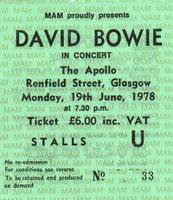
Bowie: Fashion and Unpopular Culture (Tuesday 29th October), is yet another self-annointed interesting event from Com Des and Fashion + Textiles. Open to students + staff, the general public, and space oddities.
Having enjoyed the last disjointed and dissociative blog-post so much, we thought we’d embark on another post rounding up links that might be of use in the current crop of graphics projects:
We start with this Beyond Entropy Publication. I’ve a copy, which I’ll bring in on Friday. The reason I have a copy is that it has ‘beyond’ in the title, and I buy any books that are about being beyond something. From there we move to entropy and communication, and the thought that the following films might be interesting:
Subsequently, we jump, via ambiguous symbols, to the typography topography project. The following film by Jonathan Meades asks many pertinent questions about the issues involved in this project – about money, class, ‘regeneration’, the languages of design – and it is all delivered in such a delicious style.
The clip above mentions the Islington Square development in Manchester, by FAT. From a ‘visual-language’ point of view, this is fascinating. In a style that is self-proclaimed as ‘radical post-modernism‘, questions of a dominant style, pluralistic narrative, the vernacular, the local and global are all mixed up*, with intriguing results.
Gareth’s favourite band Concert, are playing a free gig at Jan’s Bar, 18 Northwold Road, Stoke Newington, London N16 7HR, on Tuesday 24 September, 8pm. With their latest album ‘Behave Like an Audience’ featuring lyrics from Guy Ben-Ner, Mariana Castillo Deball, Dexter Sinister, Patricia Esquivias, Sharon Hayes, Hassan Khan, and Michael Portnoy, they have been variously described as ‘the Travelling Wilbury’s of conceptualism’ and a critical ‘super-group‘. Meta.
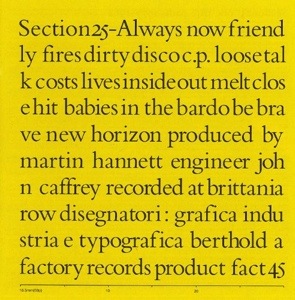
We could approach Peter Saville from a couple of different angles. One is the suggestion in the Guardian that he is the UKs most famous graphic designer. The other is as the player of a supporting role in the story of a less well-known member of the factory records family.
And finally, comrade Kieran Startup and myself are hosting a table tennis tournament, incorporating the first iteration of a live projection installation that we’ve been working on, at Good Press in Mono on Thursday the 2nd of May at 8pm.
GSA Vis Com students are currently contributing to 1913 Rite of Spring 100 Years On including MONAD. The performance is on the 18th May, and tickets are available via that link there. The project blog documenting some of the work is here.
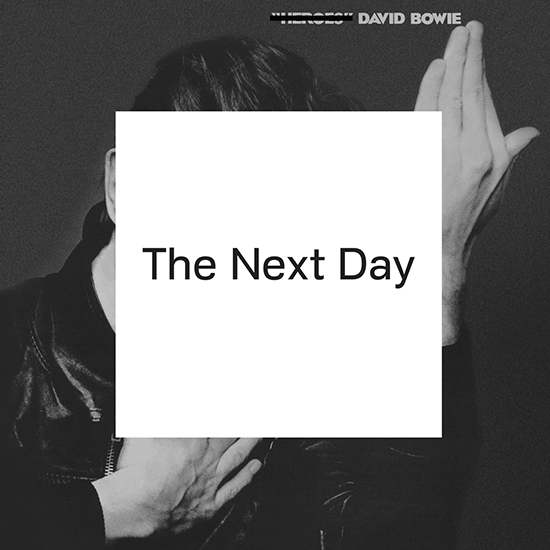
Jonathan Barnbrook answers a few questions about the cover he designed for David Bowie’s new album.
“It also has the existential element of Waiting for Godot with waiting for The Next Day – these all seem to question the nature of existence so a monochrome palette seemed most appropriate to this feeling” etc etc.
Love a bit of post-rationalisation nonsense. Also questioning (again) what an album cover actually is these days. Do people still buy music that has a cover?
In the run up to Christmas, because I’d been exceptionally good last year and worked very hard at graphic design, when I came across a copy of ‘Did You Kiss the Foot that Kicked You?‘ – a project by Ruth Ewan – I bought it for myself. The publication consists of a book designed by WillHolder (who is quite simply a very very good designer and artist), and a 10″ red vinyl of 8 interpretations of the ‘Ballad of Accounting‘ – a song, popularised by Ewan MacColl (who wrote it) and Peggy Seeger with a great title that is at first glance an unusual and odd coupling, and at second glance forces you to re-think the word ‘accounting’ in its broadest context.
As a Christmas present, I also received a copy of 33 Revolutions per Minute, a fantastically well researched and well written book by Dorian Lynskey, charting the history of the protest song. In the book there are many mentions of Peggy and Peggy’s brother Pete Seeger, who along with Alan Lomax and Woody Guthrie (1) could be said to constitute a central part of American folk music (and by association many of the political and social issues) of the 20th century. (There are also several references to Greil Marcus in the book, who coincidentally is also quoted on the reverse of Hal Fosters ‘Design and Crime‘ which is a key reference text in one of this terms forthcoming projects. Fascinating).
You can read about all aspects of Ruth Ewan’sprojecthere, but in common with the Ballad of Accounting itself, I particularly like the reflective questioning nature of the title. The song itself is structured around a barage of questions (of which ‘Did you kiss the Foot …’ is one), seemingly directed by the singers at themselves as much as anything, and as such, might be considered to be a bit ‘meta’. It also reminded me, for some reason that’s now unclear to me, of the inquiry-led learning advocated by Neil Postman (and Charles Weingartner) in Teaching as a Subversive Activity – which, while fairly bombastic in style, and a product of its time (the early 1970’s), contains some highly pertinent observations and thoughts on learning and teaching.
At the outset of this post I had a sense that this would all come a full circle, and join up with where we started. But it hasn’t.
1. Full-time GSA staff Doppelgänger and part-time singer/songwriter Billy Bragg, in a collaboration with Wilco, recorded a number of Guthrie’s unfinished songs in the Mermaid Avenue series of recordings. One of Bragg’s earliest songs, A New England, was recorded and released by Kirsty MacColl, daughter of the aforementioned Ewan. Compelling!
“Field Studies is a four-day summer-school led by three acclaimed sound artists and composers. It explores the possibilities of engaging with places through listening, and working with recorded sound as a creative and practical tool in the context of architecture, the city and art practice.”
Clockwise from top left, reconstructed overheard conversations, fishing for sounds using DIY hydrophone and the shoe-less Davide Tidoni discusses exploring space with radio static.
I didn’t manage to get the obligatory photo of artists/designers on laptops around trestle tables, it did happen though!
In Christina Kubisch’s talk, she showed films of her electromagnetic induction headphones in action. They pick up electromagnetic fields from electrical devices and convert them into sound using something like this. Reminded me of the sunglasses scene from They Live.
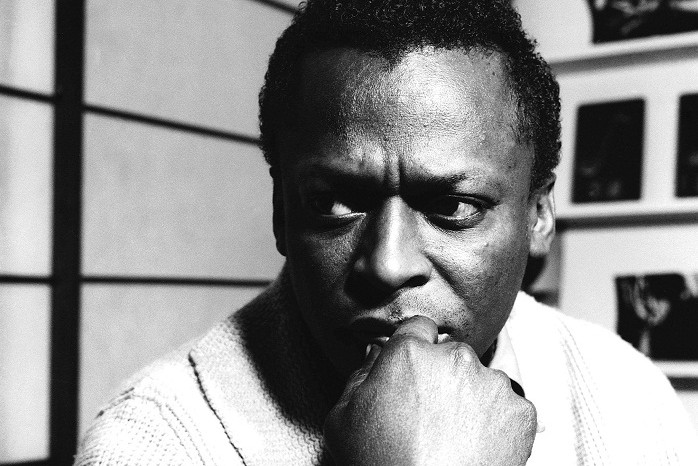
My friend Keith sent me this link, to an article where Miles Davis is asked to comment on other musicians. I thought it was interesting primarily because it was quite funny, and secondly that we often talk about criticism and strong opinions (and their presence, or lack) in studio discussions, and thought this was, in some small way, relevant.
The only thing these following two videos have in common is that they’re both black and white, (and I saw them both at round about the same time). That’s what passes as a connection these days.
‘I See a Darkness’ could be said to be a fine self-cover version of a Bonny Prince Billy song, using the lanes and Necropolis of Glasgow as the unlikely backdrop.
(The title of the post comes from the comments section of YouTube).
Vis Com 12 is the website of this years graduating 4th year students. And representing as it does, a fantastically diverse body of works, has the most tags of any post on the vis-com blog ever.
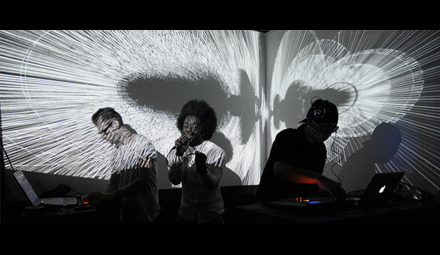
Vis-com-des person Sisi Lu is performing as part of Colour Deaf, initially developed with the Telfer Gallery, and now part of the Cryptic Nights Programme:
Thursday 7 June – Friday 8 June 2012, 8:00pm, Adult: £5.00
Installation open from 8pm, Performance begins at 9pm
“Colour Deaf is a cross-disciplinary collective, offering audiences an alternative experience in visual art and live music through installation and sonic design.”
In There Is Business Like Show Business* on Radio 4, Will Young (yes, I know, bear with me) examines the intriguing world of Industrial Musicals — lavish and complex musical theatre devised in the post-war years by corporations to play as informative, entertaining and supposedly morale-boosting features within trade-conventions — mainly to private audiences comprising of corporation staff. It cites examples such as ‘Tractor Man’ — a whole musical devised around the benefits of productivity enhancing Ford Tractors — as examples of a time when corporate budgets (and optimism in the power of consumerism) were at an all-time high, and provides an interesting insight into a very different way of thinking about brands, design and marketing — one which manages to be simultaneously sinister, nieve, and endearing, in a nostalgic kind of way.
I was interested in this as lately I’ve been reading a bit about Fordism and Post-Fordism — the influence of mechanisation on our way of thinking about the world, and the subsequent paradigm shift to a more ‘flexible’, ‘knowledge’ based economy. If you’re interested in exploring this more, this book is a good starting point (in an art and design context). I’ve also really got into this dictionary of ‘Critical Theory’ lately**, and have found it to be a handy route in to a lot of the phrases, terms and people that crop up in articles, discussions etc, but which I know nothing about. There’s a clear and easy to understand definition of Fordism and Post-Fordism in that.
* Available to listen again till Saturday.
** Realise that for the ‘haters’ out there, it’s going to be difficult to decide whether to ‘disrespect’ me for promoting a Will Young radio-show, or touting a dictionary of Critical Theory.
*** The clip used to illustrate this post is not really from the ‘golden era’ of Industrial Musicals – its from a slightly later period, and therefore lacks the production values (and budget) of some of its predecessors. But it was one of the few clips I could track down online. It was made by Allied Chemicals, and this ‘number’ is ‘The Great American Consumer’, from Seein’ the Light, 1978.
The views expressed on the Visual Communication blog are at the very most those of the authors, and possibly not even that. Any similarities to hyperlinks either live or dead are purely coincidental.








Recent Comments