
Incase you have not come across it already. A great site for sad people, like myself, that like pens. Who can ooh and ahh , (and if they are small and cute even awwwhh) for hours at CULT OF PENS here.
Communication Design Department Blog / Glasgow School of Art
Incase you have not come across it already. A great site for sad people, like myself, that like pens. Who can ooh and ahh , (and if they are small and cute even awwwhh) for hours at CULT OF PENS here.
So Peter Doig’s exhibition in the National Gallery (Edinburgh) is so good, that I cant actually find any reviews complaining about it.
Its painting, or fine art, and we are in Skypark, so it is irrelevant to us and our creative practice. BUT wait!
Beside it’s mammoth, painterly canvasses and faux-niave figures (which are, illustrators, very illustrative) the exhibition also contains a great set of film posters by Doig which are really interesting. The “Studio Film Club” posters advertise a non-commercial film club organized by the artist.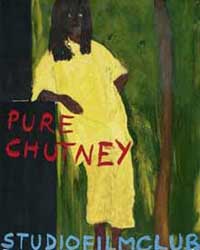
“Weekly on Thursdays, international film productions are shown in Peter Doig’s studio, without which an audience on the island of Trinidad would remain deprived of a tradition of programmed cinema. For every one of these the artist paints a film placard.”(link)
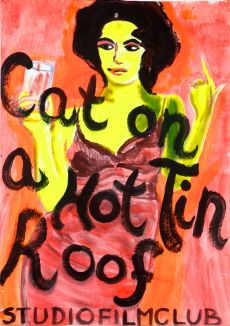
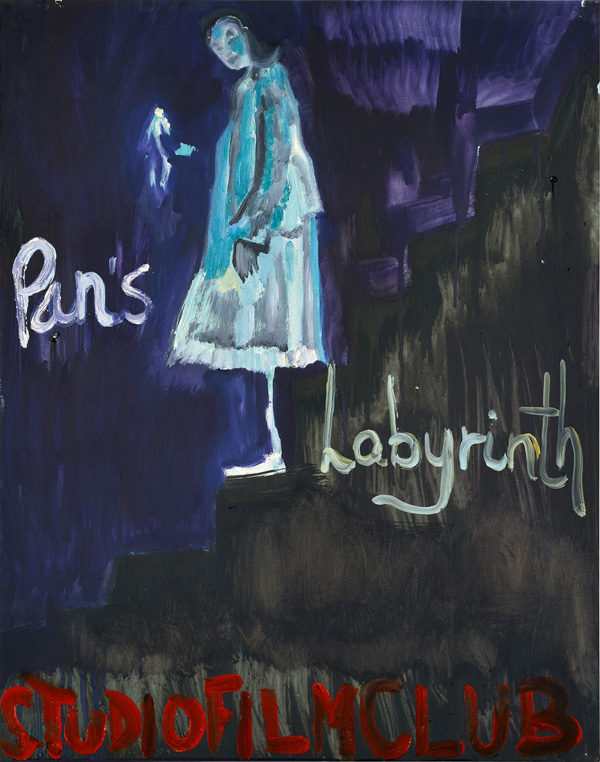
So from a graphics and illustration point of view these works are really interesting. And really the whole exhibition is pretty captivating and totally worth the £6 student entry.
some more thoughts on the exhibition by a journalist

Gareth’s favourite band Concert, are playing a free gig at Jan’s Bar, 18 Northwold Road, Stoke Newington, London N16 7HR, on Tuesday 24 September, 8pm. With their latest album ‘Behave Like an Audience’ featuring lyrics from Guy Ben-Ner, Mariana Castillo Deball, Dexter Sinister, Patricia Esquivias, Sharon Hayes, Hassan Khan, and Michael Portnoy, they have been variously described as ‘the Travelling Wilbury’s of conceptualism’ and a critical ‘super-group‘. Meta.
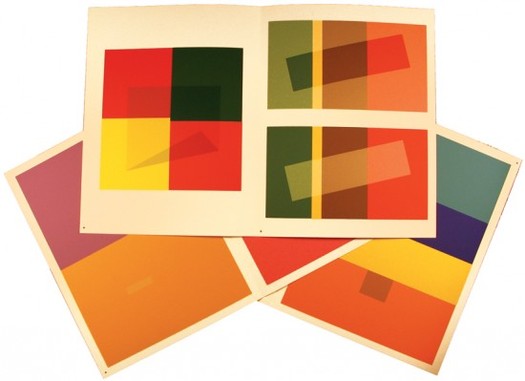
The Tricky Science of Color Perception on Design Observer reminded me that this summer saw the 50th anniversary reprint of Joseph Albers ‘Interaction of Colour’. Albers involvement in the Black Mountain College, one of my all-time top ten off-beam alt-educational experiments, is a story for another day.

NEW BOOK PROJECT! Helvetica, Objectified and Urbanized: The Complete Interviews
Greetings friends, Gary Hustwit here. Over the past eight years I’ve had the pleasure of having conversations with an incredible group of designers for Helvetica, Objectified and Urbanized. But while each conversation might last two hours or more, we only get to use maybe two minutes of it in the film. So if you’ve watched my three documentaries, you’ve actually only seen 3% of the conversations we recorded. That means there are almost 100 hours of amazing interviews that we weren’t able to show you. So we’re going to release the full text of these interviews in a book! And we’ve launched a Kickstarter campaign to make it happen. You can get all the details here.
The book will include in-depth discussions with designers and thinkers like Paola Antonelli, Alejandro Aravena, Chris Bangle, Michael Bierut, Ronan and Erwan Bouroullec, Neville Brody, Tim Brown, David Carson, Matthew Carter, Candy Chang, Yung Ho Chang, Wim Crouwel, Ellen Dunham-Jones, Tobias Frere-Jones, Experimental Jetset, Dan Formosa, Sir Norman Foster, Naoto Fukasawa, Jan Gehl, Jonathan Hoefler, Jonathan Ive, Hella Jongerius, Bruce Katz, David Kelley, Rem Koolhaas, Rahul Mehrotra, Bill Moggridge, Marc Newson, Oscar Niemeyer, Enrique Penalosa, Michael C. Place, Rick Poynor, Dieter Rams, Karim Rashid, Alice Rawsthorn, Stefan Sagmeister, Paula Scher, Erik Spiekerman, Davin Stowell, Jane Fulton Suri, Massimo Vignelli, Rob Walker, Hermann Zapf, and many more… over 75 of the world’s most creative and innovative people.
We want this book to be the most comprehensive design interview book ever published, an invaluable resource for designers, design educators, or anyone interested in the creative process. We’ve got lots of great rewards, so we hope you’ll back the project now and join us in making this happen.

Francis Atterbury at Hurtwood press has launched a high quality print service for artists and photographers who want small run digital print editions called Artisan Books.
Eye recently reviewed the service here. We are hoping Francis will send a sample up to let us see for anyone considering a limited edition book. Artisan books is available here.
We hope Francis will be able to make it up some time soon to talk about print to students.
Short Notice, Long awaited.
We will be heading down to this Velocty Talk, “Art and Therapeutic Design for Healthcare settings in Glasgow” with Jackie Sands, and Chris Fremantle.
Looks to be of great interest to Visual communicators, service designers, innovative people and thinkers with an interest in health.
“Jackie Sands and Chris Fremantle will talk about developing Art and Therapeutic Design Strategies for Healthcare settings in Glasgow; including Working Well: People and Spaces the Therapeutic Design and Art Strategy for the New South Glasgow Hospitals.”
Booking essential through eventbrite
This talk will be held at The Lighthouse from 17.30-19.30 on Thursday 19 September.

Preserving Sound: A documentary on the British Library’s Sound Archive
excellent short documentary from The Wire that is worth watching if you have even a passing interest in sound, digitization, libraries, curating, archives, the minute technical specifications of turntable stylus
The Wire takes a tour of the British Library’s Sound Archive, deep below its London residences on the Euston Road, to talk about sound conversion and conservation, and take a tour of its collections with some of its key sound curators.
The 20th century was about audiovisual material, our memory of the 20th century is heavily audiovisual, but our sense of the 21st century is going to be a different kind of audiovisual… archiving is not going to be so much about what we can bring in, but about what we can exclude,” says Will Prentice, British Library Audio Engineer and Conservation Specialist.
Rogg Hogg graduate 2013 will be showing his film at The Ottawa International Film Festival
http://www.animationfestival.ca on the Centenary year of Norman McLaren, born in Stirling 1914, studied at GSA and who formed the Canadian Film Board. All the best with the showing.
Neighbours by Norman McLaren, National Film Board of Canada

Concrete Flux 流泥 is a multi-media, multi-disciplinary online journal, (edited by Solveig Suess, Vis-com-des person), which takes as its subject matter China’s hyper-fast emerging urban spaces, their meaning and one’s everyday experiences of them. They believe that a new configuration of space through urbanisation will lead to a new configuration of society. Their aim, then, is to contribute to some understanding of or gain insight into what these spaces, which seem to emerge faster than our minds can log and assess, may mean. Issue 1: Beijing is now live.

Ivan Illich is a very interesting thinker. I fully realise that starting blog posts with these kind of sentences is glib to say the least, but it’s very difficult, (in blog form and time-limit), to outline why. He’s a perceptive critic of institutions and of many of the givens of contemporary society and contemporary design. Possibly best to defer to giving a flavour of his work; this is from a text he gave at John Thackara’s Doors of Perception conference in 1996, the full link is at the bottom;
“…Here I speak to a very special kind of shaman — not teachers or physicians, not prison officials or transportation engineers, but designers. They do not conduct, rather, they design liturgy. They do not govern the enclaves, but act as advisers to those who construct them. They are not the progeny of shoemakers or masons, but the descendants of a Renaissance brain child, the disegno. They are experts in the intentional and reflected integration of sundry artefacts; sources of a new weave that distinguishes the Baroque from the Gothic.
However, designers not only provide the shape of integration, they inevitably spread guiding assumptions about the principles to which the elements of a whole ought to be subservient. Both the cockpit of the car and the humble door handle sell ergonomics; they tickle and attract your seat and your hand. For half a century ergonomics — things designed to fit the body — has been an assumption spread by designers. But the new given you want to put on the agenda, speed, has the power to disembody. It disembodies one’s perception of the falcon no less than of the Beethoven sonata. That is what my friends Trapp and Rieger have just tried to explain, and that is also my main point.
For decades, design has peddled speed, most of the time surreptitiously and uncritically. Faster seemed better. Now you want to open a new epoch with the claim that slow speed can be beautiful, and appropriate speed optimum. You want to open an era of intense speed awareness, and promote it by means of design. You want design that hails the postmodern slobbies: slower but better working people who punctiliously protect their appropriate pace.”
via Speed? What Speed? Prisoners of Speed, by Ivan Illich: Change Observer: Design Observer.
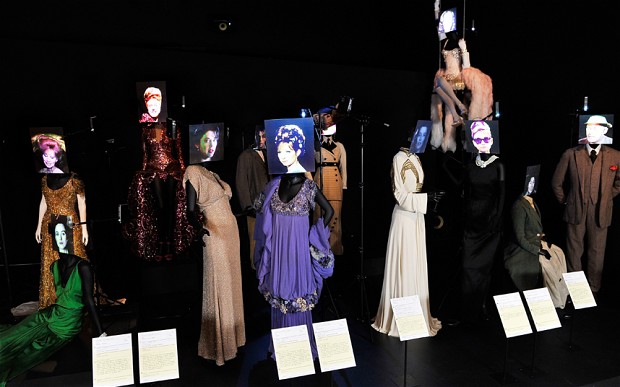
Its the start of term and rumours are flying thick and fast here at GSA Com-Des HQ. First up, studio is rumoured to start back on the 16th September. Make of that what you will. Secondly, Com Des are rumoured, along with Fashion and Textiles, to be co-promoting the following talk event with Prof. Deborah Nadoolman Landis, prominent costume designer for film, on Tuesday 17th September. Thirdly, I’ve heard it said, and google analytics aren’t denying it, that this is the most popular vis-com-des blog post of the last year.

We could approach Peter Saville from a couple of different angles. One is the suggestion in the Guardian that he is the UKs most famous graphic designer. The other is as the player of a supporting role in the story of a less well-known member of the factory records family.

The Old Hairdressers Saturday Salon Matinees
Saturday Sept 7th – Three Glasgow Film-makers
Duncan Campbell best known for his ruminative documentaries on Bernadette Devlin and John DeLorean, brings us the Glasgow premiere of It For Others (2013) his latest piece, made for the Venice Biennale earlier this year, Taking it’s cue from ideas discussed in Alain Resnais and Chris Marker’s Les Statues Meurent Aussi (Statues Also Die), It For Others is “a film about objects” and includes a remarkable 10 minute sequence involving dancers from the Michael Clark Company. Margaret Tait Award winner Anne Marie Copestake (And Under That) is showing a short film and there is a new piece by Kimberley O’Neill, a collaboration with typographer and bon vivant Edwin Pickstone. Discs spun by Fantom Salon DJs and The Phantom Band’s Duncan Marquiss.

If you have ever chicaned the Kinning Park slip road from the M8, you will have noticed the crumbling Gray, Dunn & Co. biscuit factory to your left. This reminded me of a childhood favourite sadly missing from our convenience stores – the Gray Dunn Caramel uncovered wafer block. To exorcise my loss and seek closure, I have rendered it in macromedia Freehand (a redundant programme I was using when the factory closed in 2001). It is a homage to what was a uniform slab of wafer layers, caramel and a yellow cream (lighter than a custard cream). Tunnock’s may take all the neo Pop Art plaudits (note use of Rockwell Extra Bold hybrid on their caramel wafer), but the Gray Dunn was always the superior biscuit on taste and texture i.e. you could get the gnashers through it – not too chewy or crunchy – more ooze than the woodier Tunnock’s.
I have some issues with Dr Aleks Krotoski’s BBC Radio 4 programme – Last Bus to Serendip, (but yes, we all have issues don’t we, hmmm, critical designers, hmmmmmm, sitting round, having issues with things). Anyway, despite these ‘issues’, there are a couple of good interviews in there – the best with James Burke, presenter of Connections, an episode of which you can see above.
Recent Comments