
As a provocation, Collage Culture raises some interesting questions.
Communication Design Department Blog / Glasgow School of Art
Just did a shit tweet on Twitter about how I’d just put a ‘shit-load’ of links on recommends.tumblr.com/ for current 3/4 graphics projects, based on our discussions of past days/weeks.
Recommends is a work in progress, currently in beta, soon to progress to ceta. It’s a kind of digital ‘dump’ for references (links, pictures, quotes, books etc etc) pertaining to projects. You too can add to the dump by using the ‘submit‘ button on the site, or mailing stuff to 905smaprok[at]tumblr.com, where it will magically appear on the site (about 2 hours later).

From Rob Walker, ‘The Work of Art in the Age of Googled Reproduction‘. Connects (in my mind) with this (or this). (And this).

While London burns, (hope all friends of Vis Com in the capital are ok), I am wondering where (if at all) this connects with recent activities of the Deterritorial Support Group (DSG). A friend brought this to my attention, and has recently posted an interesting article on this here. On an equally interesting, but lighter note, Type Tuesday is a very good recent (I think) addition to the Eye Blog. So two things happening on a tuesday.

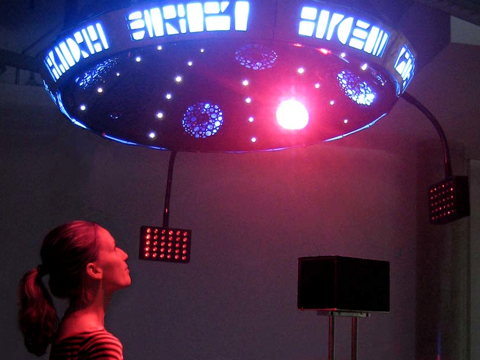
Talk to Me is the latest exhibition from Design and the Elastic Mind curator Paola Antonelli. This coincides with a recent purchase of mine, a HP desktop printer/scanner which not only talks to me (giving me printing ‘tips’ via its built-in lcd screen), but via its own I.P. address and a wireless connection to the network, talks to Hewlett Packard HQ… about me? about what I print? about how I’m not very good at loading the paper? The Internet of Things is well and truly here.
A Domus review nicely summarises some of the key questions;
“In the catalogue text, these changes are read along the long wave of opposition to cold 20th century rationalism: “The clichés of the twentieth century, such as ‘form follows function’, the modernist motto borrowed with some variation by Louis H. Sullivan, and ‘design means solving problems’… have been responsible for soulless and lobotomized architectural design.” On the contrary, the experiences shown in Talk To Me go back to the 1960s and the fruitful experiences of the radicals with their first ideas regarding cybernetic, mobile and interactive architecture.”
via Talk to Me – Design – Domus.

“Tristram Shandy is not only significant in the cultural canon as a non-linear forerunner to Joyce, Woolf, Beckett, Godard, Eno, Greenaway and Tarantino, but playfully and brilliantly constructs and deconstructs the conventions of narrative. It makes use of multiple media as devices to tell its stories, and, in actively soliciting a dialogue with its reader, it demands a creative participation from its audience. Tristram Shandy is the direct antecedent of contemporary hypertextual and non-linear, convergent media experiments”.
via Asterisk at Shandy Hall | The Laurence Sterne Trust.

The Serving Library is online, and the first edition is out in print. Making the articles available online as PDF’s, and by print then post distribution, in parallel, (and with an online document of those recently ‘served‘) questions are raised about the false dichotomy of analogue vs digital. On a purely practical level, students (or others) with zero budget (but a functioning network connection) can download and read/print some very interesting design/art/media documents. Below is a beautiful picture of me interacting with the Serving Library through the arcane/bizarre/logical aesthetic and anti-perspective quandry that is iBooks.
More on the Serving Library statement of intent here.


Loads of interesting reports now online from the Unbound Book conference. Some in Dutch, some in English. Dare-say video’s may follow.

Manystuff offer some very comprehensive coverage of the first Amsterdam Art/Book Fair. The kind of place where I could bankrupt myself. They also do the animated gif meme.
Video Vortex is a really interesting conference run by the Institute of Network Cultures, and which focusses on the messy but interesting world of online video, the most recent one looking at Online Video Aesthetics, Platforms, Standards and the Trouble with Translation, Civil Rights, Online Video Art and Online Video as a Political Tool. It has much to say about how images are created and transmitted, and what’s really great is that the Readers which accompany each conference are free to download from their website.
1st Year Department of Visual Communication
London Study Trip
24-27 January 2011
25.1.11
DAY 1
VISIT / 10.00am
– Company / Alex Swain
http://www.company-london.com/
– An informal insight into business acumen combined with how to take a client on a creative journey.
VISIT / 11.30am
– The Association of Illustrators / Paul Ryding
http://www.theaoi.com/
– There is very little former graduate Paul Ryding does not know about contemporary illustration.
VISIT / 1.00pm
– Tomato / Michael Horsham
http://www.tomato.co.uk/
– An intimate sharing of large and small projects from one of the most influential agencies. There portfolio goes back to 1991 and are continuing to work with Underworld.

VISIT / 4.00pm
– Pentagram / Jane Pluer
http://pentagram.com/en/portfolio/
– One of the most impressive offices in the creative industries with a workshop to match. Imperious work delivered with style and elegance.

26.1.11
DAY 2
VISIT / 11.00am
– Browns Design / Jonathan Ellery
http://brownsdesign.com/
– Jonathan engaged with the students immediately by asking how they defined art compared to design. Award winning work from a man who applauds the students form outside London including The Glasgow School of Art.
VISIT / 1.30pm
– Field / Vera-Maria Glahn
http://www.field.io/
– A German duo working with all the latest programming software and code to produce really beautiful ‘cross-media’ work. Cool rooftop garden with views over to the City of London.

VISIT / 4.30pm
– Build / Nicky and Michael Place with former graduate Lynne Devine
http://wearebuild.com/
– Michael allowed us to touch, feel and sniff the quality of his best design for print. Designers Republic guru happy to be working in a small agency with one of our best graduates.

Passing through witte de withstraat yesterday saw this exhibition, but unfortunately didn’t have time to go in. However, via retweet from v2, see that they’re putting their publication online:
Also in the ‘doing is thinking’ vein: http://www.dexigner.com/news/16225


Documenta 13 is the latest incarnation of the renowned art festival, which has now become, as many art festivals have, a “county fair for intellectuals“. Manifesta is a more itinerant version of its sound-a-like equivalent. Unitednationsplaza is what happened when the Greek/Cypriot government cancelled Manifesta in 2006, its video archive is now online. UNP was organised by (amongst others) Anton Vidokle. Open 16 investigates the phenomena of the art biennial, with some fascinating and critical writing.

These initial forays into a web-based Afghan culture museum, which I came across via this article, caught my attention, as it overlaps with some other interesting stuff I’ve come across recently about curating, museums, archives and how we create and propagate collective ‘memories’ in a digital/networked context.

This forthcoming event at The Show Room in London may well reflect in interesting ways on the recurring conversations here about information overload, attention and feedback-fuzz.

If you’re an apple drone like me, and have an iPhone, iWould highly highly recommend the design observer app, which is free. Nice interface and navigation, easy to peruse, and now with an expanded roster of regular writers, adding the likes of John Thackara* to the usual line up of Helfand, Beirut, Poyner, Shaughnessy et al, it’s an impressive resource. I’m also intrigued about how the book continues a forceful dialogue with design for devices. Obviously the visualising and linking functions constitute the ‘new’ and add value, but within a design system where one of the main prerogatives is that line length and overall layout needs to be visible in a small portrait rectangle as per small cheap paperbacks etc, the 1024×768 browser window being recinded to pocketbook size**. As noted previously, Wired Magazine are claiming the ‘death of the web’, and see the future in apps — while I’d contest that point, it seems that there maybe is something of the ‘managable’ book collection about a set of apps, as opposed to the free-for-all chaos and information-glut that is the unadulterated web (a “slag heap of information” to quote one of the Country’s leading case-room typographers and technicians)— I still prefer the later but can see the point about the former.
Back to Design Observer, a fascinating post there recently by Rick Poyner discusses Agency or studio? The Dutch graphic design dilemma. There are so many worthy discussion points within the article — functional modernism and misfiring humanism, the fetishising of simplicity, branding, blanding etc etc — that I don’t think I can do them justice here, but if anyone wants to pick up the discussion, let me know…
And speaking of dutch design, I’m going to this conference tomorrow, providing Glasgow Airport is functioning at 5am, and will blog the proceedings in the near future. I may even do a tweet. But that’s enough about my personal arrangements, this is a high-brow educational design blog after all.
Merry Christmas.
* I found out a really interesting new word out from John Thackara recently; “catagenesis“, which sort of means “renewal through reversion to a simpler state — followed by the emergence of a novel form of society.”
**In reality it’s not the book per-se, but the human hand or human pocket that exerts such a powerful influence on interface (GUI) design. Yes, it’s true, until our trousers have pockets the size of a laptop and we evolve spindly 10 inch fingers, the web will be curtailed by our bodily and sartorial limitations.



Recent Comments