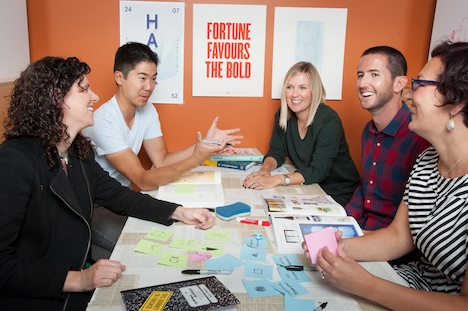
In this image, only two people are looking at each other. The others are failing to connect, and looking somewhere in to the middle distance. Perhaps they are contemplating the significance of the vaguely retro ‘letterpressed’ poster invocation that ‘fortune favours the bold’, and wondering how they can inject some of this faux-authenticity into facebooks offering. The image is used (and it’s good to speak to Edwin on this point, as he has a lot of interesting research about the use of ‘nostalgic’ design/typography by contemporary corporations and organisations) as an attempt to illustrate a point in an article; Designing Delight: Behind the Scenes at Facebook, on Core 77, (which is written by Facebook’s Director of Design, Kate Aronowitz, and is therefore technically an advert, rather than an article).
‘Social Design’ is Facebook’s current buzz-phrase, and the article does absolutely nothing to illuminate in any detail what exactly social design might mean, other than some vague references to all interaction design being more to do with the human than the machine, and some of the usual stuff about open-plan offices, open-plan innovation, and open-etc-etc.
What the article perhaps inadvertently highlights is a possible recent shift in the meaning of the word ‘social’, from one that was quite politically charged and value-laden (social security, social welfare etc) to one that has, in a web 2.0 context, become quite neutral, describing instead a technical function (of share, ‘like’, re-post etc). I first came across this idea, via Geert Lovink and Networks without a Cause.
Meanwhile back in Facebook-land, the unrelenting wheels of progress continue to turn and the weekly meetings with ‘mark’ grind on. But maybe they’re still not quite as entrenched in the work/life/office of the future, as googlers at the google-plex:
0 Responses to “Office-based rollerblades (despite lack of practical application) remain popular as social signifier amongst 25–45 year old man-child demographic”